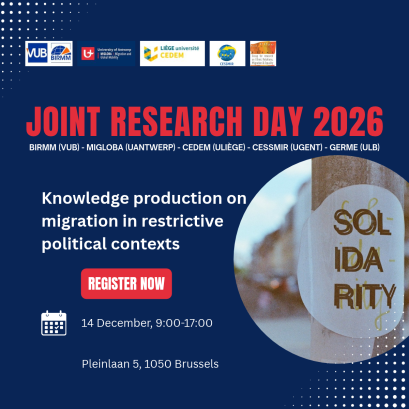
BIRMM (VUB), CEDEM (ULiège), CESSMIR (UGent), GERME (ULB) and MIGLOBA (University of Antwerp) warmly invite you to the sixth edition of their joint research day.
The 2026 edition will focus on knowledge production about migration amid increasingly restrictive and violent migration policies and discourse in liberal democracies, including Europe, the United States and Canada. At a time marked by an erosion of the rule of law, migrants face growing risks, while civil society organisations working in solidarity with them and researchers studying migration and diversity are coming under mounting pressure.
The research day will explore what this context means for conducting, disseminating and collaborating on migration research. Together, we will consider:
- How can researchers engage with policy debates when migration is politically contested?
- How can migrant voices be heard without exposing them to additional risks?
- How can researchers respond to backlash against their work?
- How can research continue to contribute to societal transformation and alternative futures?
- How can we build alliances within and beyond academia to support these goals?
Throughout the day, researchers will share practical examples of how they have navigated these challenges in different contexts and developed possible responses. We will revisit the debate between policy-relevant and policy-irrelevant research and discuss how researchers can address state-centred priorities that conflict with societal justice.
As in previous editions, the programme will feature inspiring talks and workshops by researchers from a range of disciplinary backgrounds, alongside ample opportunities for networking among migration scholars.
Due to a planned strike in higher education, the Research Day will no longer take place on 17 November, as announced before.
14 December 2026, 9:00 - 16:00
Location: VUB, Pleinlaan 5, Lisbon & Rome conference room
Participation fee: Free
Programme:
| Time | Activity |
| 9.00 | Registration and welcome coffee |
| 9.30 | Welcome by the organising teams from BIRMM, CESSMIR, CEDEM, GERME and MIGLOBA |
| 10.00 | Keynote 1 by Thomas Huddleston (CEDEM, ULiège): 'Belgian Migration Studies in the Face of Trumpification' What does the 'Trumpification' of migration policy mean for migration policy, civil society and researchers in Belgium and Europe? This keynote expands on how specific migration policies are weaponised in democracies in decline, not only in the Trump's America, but increasingly across Europe, including Belgium's Arizona coalition. This keynote reflects on how migration researchers can better conceptualise, identify and document these processes at a time when academic freedom and civil society are potentially under attack. |
| 10.45 | Break |
| 11.15 | Keynote 2 by Laura Stielike (Osnabrück University): ‘Complicity and Critique: The Moral Economies of Knowledge Production on Migration in Times of the Digital, Authoritarian and Reflexive Turn’ This talk examines how three recent technological, political and scientific developments transform the moral economies of knowledge production on migration. The digital turn provokes new knowledge practices and ever-growing funding competition. The authoritarian turn questions the epistemic authority of scholarly migration knowledge. The reflexive turn complicates truth claims in defence of (post)migrant societies. Given these shifts, how can migration scholars avoid complicity with anti-migration discourse and what new possibilities for critique emerge? The speaker proposes a threefold strategy: developing reflexive science communication, reflecting on academic care work and assembling critique for the future of migration research.
|
| 12.00 | Keynote 3 by Abdel Karim Daragmeh (An-Najah University): 'Mapping Forced Immobility: Children's Spatial Narratives and Knowledge Production under Occupation' Migration and mobility are increasingly shaped by restrictive political regimes, securitisation, and unequal access to space. While contemporary debates on migration frequently focus on border crossings, displacement, and exclusion in liberal democracies, the situation in occupied Palestine draws attention to another, interconnected dimension of mobility governance: the systematic regulation, fragmentation, and destabilisation of everyday movement. In the occupied West Bank, particularly in Area C, restrictions on mobility affect not only possibilities for displacement but also the ordinary movements through which people access education, livelihoods, healthcare, and social life. Here, mobility is not simply a matter of crossing borders but of negotiating a landscape in which even the journey to school can become uncertain and often unsafe. This keynote examines how Palestinian children living in marginalised Area C communities experience, interpret, and navigate the spatial and political constraints shaping their access to education. |
| 12.45 | Michèle Levoy (Director of PICUM): Reflections from civil society |
| 13.15 | Lunch |
| 14.30 | Parallel workshops
|
| 16.30 | Closing comments |
*Please note that for Workshop 3, a passive knowledge of French is required.
We look forward to welcoming you!