

The Postracial Discursive Contract: Complicity and collaboration in the (un)hearing of race
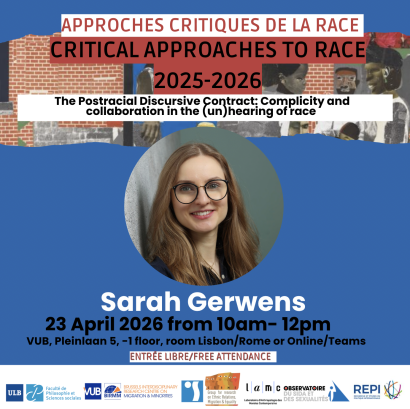
In many contemporary European settings, race is expected to remain unseen and unspoken. The literatures on colourblindness, postracialism, and racelessness have explored how white people in particular avoid race talk and distance themselves from any association with racism. In this seminar, Sarah Gerwens argues that race is far from absent or forgotten. Instead, seemingly “raceless” conversations often rely on relational assurances such as “Do you know what I mean?” and “I didn’t mean it that way.” Focusing on these dynamics, she suggests that race talk—especially among individuals invested in white innocence (see Wekker, 2016)—requires active collaboration between speaker and listener in order to occur without rupture. Drawing on a critical discourse analysis of 84 relational interviews with parents, school staff, and education administrators, as well as field notes and documents collected during nine months of ethnographic fieldwork in the German city of “Stadt,” Gerwens introduces the concept of the postracial discursive contract. This concept explains how “good” race talk relies on implicit understanding and mutual reassurance. Building on Mills’s (1997/2014) notion of the racial contract and scholarship on the discursive and collusive dimensions of postracialism (e.g. Goldberg, 2015; Cho, 2008; Roig, 2017; Sayyid, 2017), she argues that not-racist race talk in “raceless” settings depends on speakers and listeners collaboratively acknowledging racial content while simultaneously denying its racial and racist implications. This shared investment in white innocence ultimately sustains white supremacy. By examining the relational dynamics that sustain racial discourse, Gerwens highlights the agency involved in both resisting and reaffirming its underlying assumptions. While previous research on race talk has largely focused on unidirectional accounts, her analysis calls for greater attention to the role of white researcher positionality and contributes to a deeper understanding of the discursive and relational dimensions of postracialism.
About the speaker
Sarah has recently finished her PhD at the London School of Economics and Political Science (LSE). Her research investigates how white people speak about race and racism in supposedly raceless settings, with her doctoral thesis focussing on German education in particular. Sarah’s findings underline the importance of following not-racist rhetoric with anti-racist actions and of remaining critical towards claims of racelessness. She has also researched Islamophobia on social media and contributed to equity and diversity initiatives in higher education. Currently, Sarah works as an Adjunct Professor at the Brussels School of Governance (BSoG) and she is a Visiting Fellow at the LSE's European Institute.
When: April 23, 10:00 AM until 12:00 PM
Where: VUB, Pleinlaan 5, -1 floor, room Lisbon/Rome or online (Teams)